



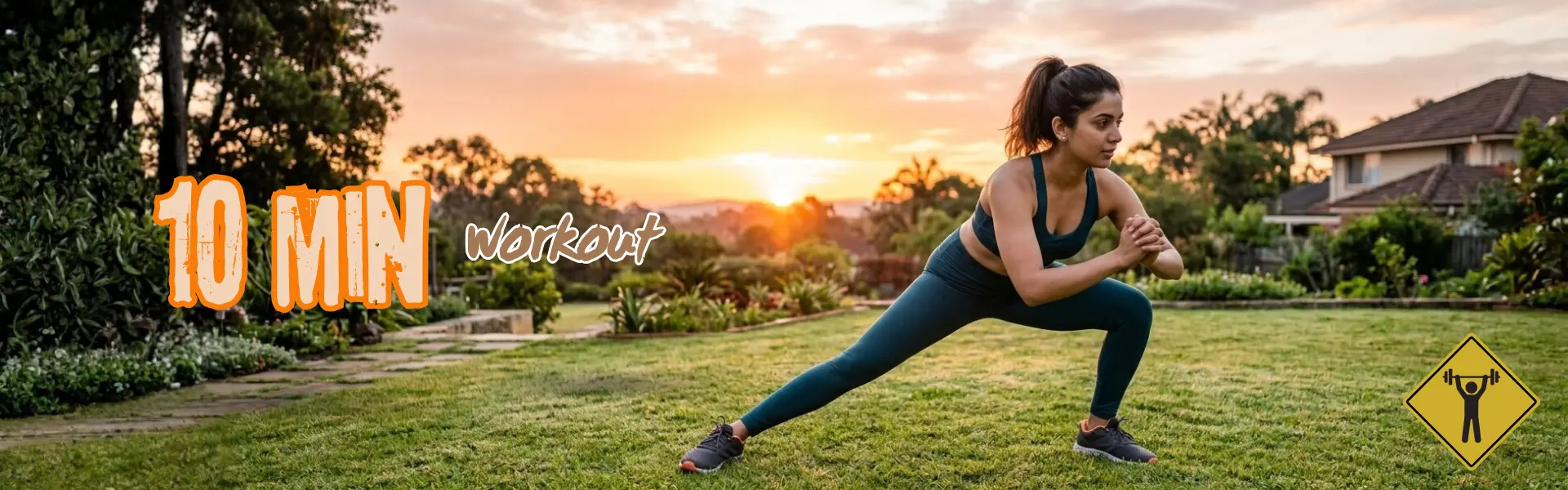
10-Minute Morning Workout Without Equipment
You don’t always need a gym, expensive equipment, or an hour of free time to start your day with exercise. A well-planned 10-minute morning workout without equipment can get your body moving, raise your heart rate, and help you build a consistent fitness habit.
The key is not trying to do everything in 10 minutes. Instead, use those 10 minutes to combine simple movements that work different muscle groups while keeping the workout practical enough to repeat regularly.
Physical activity has both immediate and long-term benefits, including better sleep, reduced anxiety, improved cardiovascular health, and support for maintaining a healthy weight.
Why Try a 10-Minute Morning Workout?
One of the biggest barriers to exercise is often time. A 10-minute workout removes the “I don’t have enough time” excuse.
You can complete this workout after waking up, before breakfast, or even before getting ready for work. You don’t need dumbbells, resistance bands, a treadmill, or a gym membership.
Interesting fact: Current U.S. physical-activity guidelines no longer require exercise to be performed in blocks of at least 10 minutes. Even shorter periods of moderate-to-vigorous activity can contribute to your overall activity.
That means a 10-minute workout is useful—but you can also add short bursts of movement throughout your day.
Your 10-Minute No-Equipment Workout
Set a timer for 10 minutes. Perform each movement for approximately 40 seconds, followed by 20 seconds of rest or transition.
If you’re a beginner, reduce the work period and take longer breaks whenever necessary.
March in Place – 1 Minute
Start with an easy march to warm up your body.
Lift your knees comfortably while swinging your arms naturally. Gradually increase the pace during the final 20 seconds.
Why do it? It raises your body temperature and prepares your muscles and joints for the exercises that follow.
Bodyweight Squats – 1 Minute
Stand with your feet approximately shoulder-width apart. Push your hips backward and bend your knees as if you’re sitting into a chair. Return to the standing position.
Keep your chest comfortably upright and control the movement.
Works: Quadriceps, hamstrings, glutes and core.
Interesting fact: Squatting is a functional movement you use in everyday life whenever you sit down, stand up, or pick something up from the floor.
Jumping Jacks – 1 Minute
Stand with your feet together and arms by your sides. Jump your feet outward while raising your arms overhead, then return to the starting position.
If jumping is uncomfortable, perform step jacks by stepping one foot out at a time.
Works: Cardiovascular system, legs, shoulders and coordination.
Alternating Reverse Lunges – 1 Minute
Step one foot backward and lower your body until both knees are comfortably bent. Push through the front foot and return to standing. Repeat on the other side.
Keep your movements controlled rather than trying to move as quickly as possible.
Works: Glutes, thighs and balance.
Mountain Climbers – 1 Minute
Start in a high-plank position. Bring one knee toward your chest, return it, and alternate with the other leg.
Beginners can slow the movement down or perform the exercise with their hands elevated on a sturdy surface.
Works: Core, shoulders and legs while increasing your heart rate.
Push-Ups – 1 Minute
Place your hands slightly wider than shoulder-width apart and lower your chest toward the floor. Push yourself back up.
If standard push-ups are difficult, perform them from your knees or against a wall.
Works: Chest, shoulders, triceps and core.
High Knees – 1 Minute
Stand tall and alternate lifting your knees toward your waist while moving your arms naturally.
You don’t need to sprint. Start at a comfortable pace and increase intensity only if you can maintain good form.
Tip: If you’re exercising in an apartment or don’t want to make noise, perform fast marching high knees instead of jumping.
Plank – 1 Minute
Place your forearms on the floor and extend your legs behind you. Keep your body in a straight line from your shoulders to your heels.
Don’t worry about holding a perfect plank for the entire minute. Take short breaks if necessary.
Works: Abdominal muscles, shoulders, back and other stabilizing muscles.
Fast Feet – 1 Minute
Stand with your feet slightly apart and rapidly move your feet up and down while staying light on your toes.
Keep the movement controlled. Beginners can simply perform a quick march.
This exercise adds a short cardiovascular challenge toward the end of your workout.
Cool Down & Deep Breathing – 1 Minute
Slow your movement gradually. Walk around slowly, relax your shoulders and take several comfortable deep breaths.
You can finish with gentle stretches for your calves, thighs, shoulders and back.
How Often Should You Do This Workout?
For beginners, try this 10-minute morning workout without equipment 3–5 days per week.
As your fitness improves, you can:
- Increase the work intervals.
- Reduce rest periods.
- Perform two rounds.
- Add more challenging variations.
- Combine the workout with walking, running or cycling.
- Include separate strength-training sessions.
For overall health, adults are generally advised to accumulate at least 150 minutes of moderate-intensity physical activity per week, along with muscle-strengthening activities on at least two days per week.
So think of this 10-minute workout as a starting point, not the entire fitness plan.
Does a 10-Minute Workout Help With Weight Loss?
It can contribute, but expectations should be realistic.
Weight loss depends largely on your overall energy balance. Physical activity increases the energy your body uses, while nutrition determines much of your calorie intake.
A short workout may not burn hundreds of calories by itself, but doing it consistently can help you become more active throughout the week.
Interesting fact: Research on short bouts of exercise suggests that breaking up sedentary time with brief periods of activity can provide measurable health benefits.
The real advantage is that 10 minutes is easier to repeat than an unrealistic workout routine you abandon after a few days.
Make Your Morning Workout a Habit
Try these simple strategies:
Keep it ready: Wear comfortable workout clothes or keep them prepared the night before.
Start small: Don’t wait until you have an hour available.
Track your progress: Record how many sessions you complete each week.
Increase gradually: If you’re new to exercise, don’t suddenly increase intensity or volume. Gradual progression can help reduce injury risk.
Stay consistent: Ten minutes today is better than planning a one-hour workout that never happens.
Final Thoughts
A 10-minute morning workout without equipment can be a simple way to introduce regular movement into a busy lifestyle. Squats, lunges, push-ups, jumping jacks, mountain climbers and planks require very little space and can be adapted to different fitness levels.
You don’t need to complete a perfect workout every morning. The bigger goal is to make movement part of your daily routine.
Start with 10 minutes. Build consistency. Gradually increase your activity as your fitness improves.
Your workout doesn’t have to be long to be worth doing—it just has to be something you can keep doing.